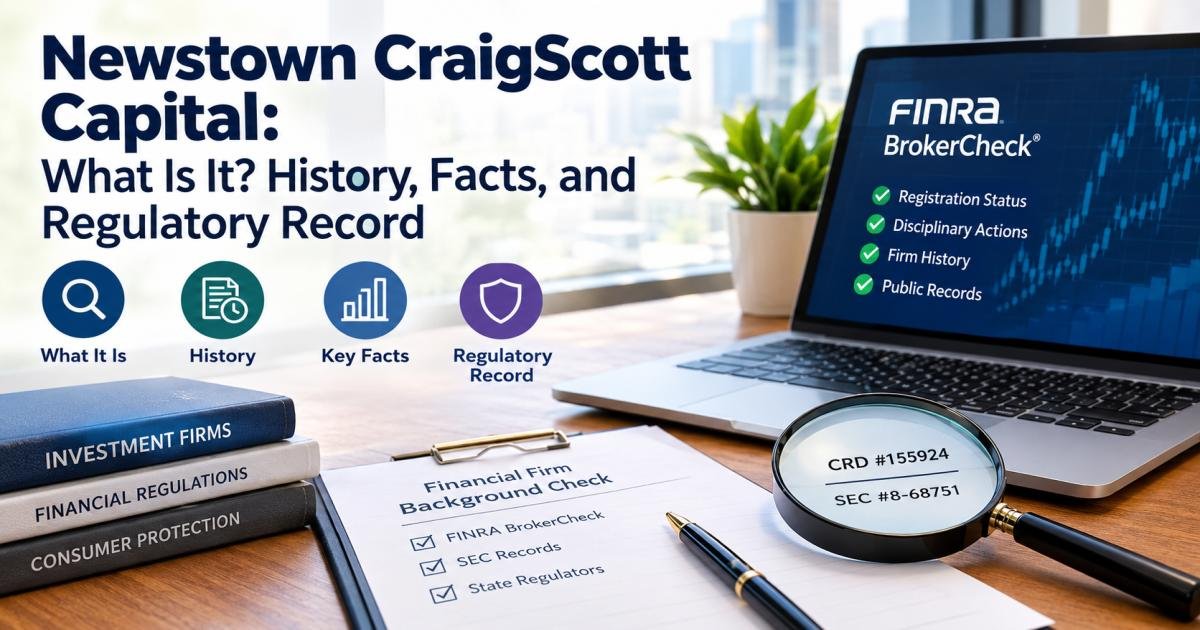

Newstown CraigScott Capital is not a registered financial firm in any U.S. record I could find. The name looks like a mash-up of Craig Scott Capital, LLC, a New York brokerage. That firm was registered from January 20, 2012, to September 7, 2017. FINRA expelled it after a hearing decision became final.
The gap between the name and the record causes most of the confusion. Some websites describe a modern wealth firm. Regulator files describe an older brokerage that lost its membership.
This guide sticks to the public record. It covers what the old firm did, what FINRA and the SEC found, and why the name misleads. It ends with a short way to check any financial firm before you send money.
Last checked: September 28, 2026. This article is general information, not legal or financial advice.
Newstown CraigScott Capital: What Is It?
Quick answer: It is an online label, not a company with its own record. I found no license, address, or named team under that exact name.
Two kinds of pages use the phrase. The first kind describes a new investment firm. One calls it a rising name in 2026. Another talks about balance, long-term resilience, and patience without giving a license number, an office, or a person you can look up.
The second kind links the phrase to the old brokerage. One page on a site called Newstown describes a registered broker-dealer based in Uniondale, New York. That may be how the extra word spread, though that is only a guess.
Only the second kind matches anything in a regulator’s files. The name and the record do not line up, and that mismatch is the whole story.
Is Newstown CraigScott Capital a Registered Financial Firm?
Quick answer: No. I found no registration under that name.
The record that exists belongs to Craig Scott Capital, LLC. FINRA’s BrokerCheck report lists it under CRD number 155924 and SEC file number 8-68751, and says the firm is no longer registered with FINRA or a national exchange. The legal name in that report is Craig Scott Capital, LLC. “Newstown” does not appear as an alternate name.
Why does that matter? A web page can claim anything. A regulator’s database is where a license shows up, and typically the only place a reader can confirm one.
The Historical Craig Scott Capital, LLC
Quick answer: It was a small New York retail brokerage that sold stocks by phone, from about 2012 to 2015.
The records give these details:
- Formed: New York, October 13, 2010, with its main office in Uniondale.
- Owners: Craig Scott Taddonio was the majority owner, president, and CEO. Brent Morgan Porges was minority owner and chief operating officer. The firm’s name matches the CEO’s first and middle names.
- Size: Between 2012 and 2015, it had 15 to 40 registered representatives.
- Clearing firm: COR Clearing LLC held customer accounts and funds.
- Lines of business: Seven, including retail stock sales, mutual funds, options, and private placements.
The sales model was simple. Junior brokers cold-called prospects to open accounts and place a first trade. Senior brokers then took over and urged customers to invest more and keep trading.
Pricing had two layers. Every trade carried a flat $99 fee, plus up to 5% as a commission, markup, or markdown (cut to 3.2% in May 2013). On most trades, the confirmation did not explain the markup in plain dollars. BrokerCheck says the firm stopped doing business on December 31, 2015.
Newstown CraigScott Capital vs. Craig Scott Capital, LLC
| Newstown CraigScott Capital (online label) | Craig Scott Capital, LLC | |
| Regulator record | None found under this name | FINRA CRD #155924 |
| Registration | Nothing to verify | Ended September 7, 2017 |
| Office | No verified address | Uniondale, New York |
| Named people | None found | Named owners and officers |
| Services | Vague claims on blog-style sites | Retail brokerage |
| Disciplinary history | None on file under this name | 10 regulatory events and 6 arbitration awards |
The right column is documented. The left column is mostly web copy.
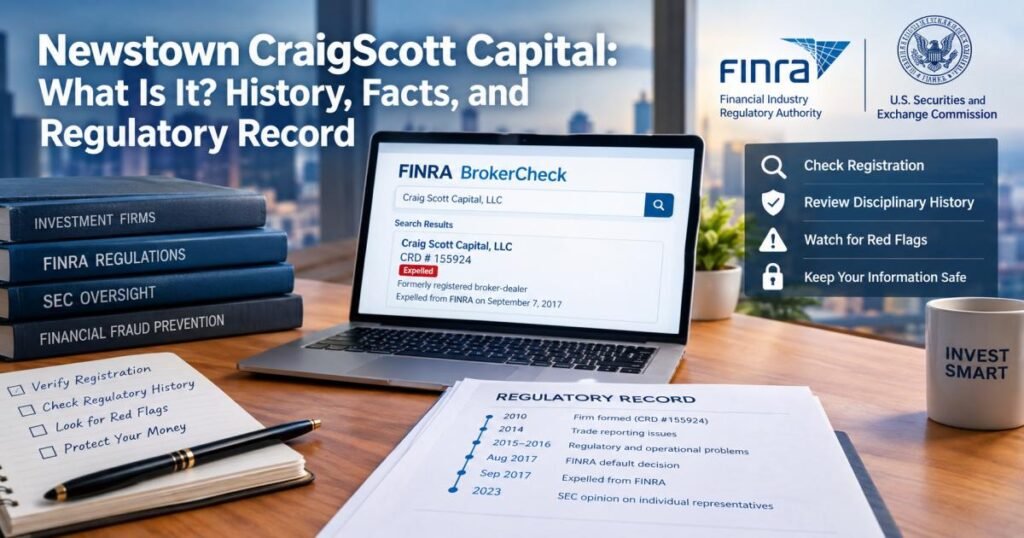
Craig Scott Capital Regulatory History: A Timeline
Quick answer: The firm’s regulatory trouble ran from 2014 to 2017, and an appeal reached the SEC in 2023.
- June 10, 2014: FINRA censured the firm and fined it $12,500 over inaccurate order data and missing customer notices.
- March 4, 2015: A second censure and a $7,500 fine for 95 flawed order reports.
- October 2015 to January 2016: FINRA suspended the firm several times for unpaid arbitration fees and missed filings.
- December 30, 2015: FINRA filed its excessive-trading complaint.
- January 28, 2016: FINRA canceled the firm’s membership over $103,867.52 in unpaid fees.
- April 12, 2016: The SEC censured the firm and ordered a $100,000 penalty.
- July 31, 2017: A FINRA hearing panel barred the two principals and one broker.
- September 7, 2017: The expulsion became final, after a default decision on August 10.
- January 29, 2019: FINRA’s appeals body upheld the findings and widened the CEO’s bar.
- April 19, 2023: The SEC sustained FINRA’s action against the CEO and one broker.
BrokerCheck also lists six arbitration awards against the firm. Added up, they come to roughly $974,000.
BrokerCheck shows both the January 2016 cancellation and the September 2017 expulsion. The 2017 event is the one most sources cite.
What FINRA Found About Craig Scott Capital
FINRA found excessive trading and churning in customer accounts, weak supervision, and false statements to FINRA.
Churning means a broker trades an account far more than the customer’s goals justify, mainly to earn commissions.
The complaint. FINRA alleged that brokers used upcoming earnings reports to recommend hundreds, sometimes thousands, of short-term trades. It said the firm, its owners, and its brokers earned over $5 million in commissions while customers lost over $9 million. Those numbers were allegations in the complaint, not final findings.
The decision. The final findings were narrower. Three representatives excessively traded the accounts of 11 customers, measured by cost-to-equity ratios and turnover rates. Turnover shows how often an account’s holdings are bought and sold. Cost-to-equity shows how much the account must earn just to break even.
FINRA also found that the representatives had de facto control of the trading, that the trading did not match customer goals, and that the owners knew of red flags and did not act.
Two smaller findings. The firm had no reliable system to keep brokers from calling numbers on the do-not-call list. In a three-month review in 2014, its sales force placed 1,330 calls to 1,038 listed numbers. FINRA also found the firm gave false information about call-recording equipment.
The sanction. No fine was imposed, because the expulsion itself was the penalty.
The people. The hearing panel found the principals failed to supervise and gave false testimony, and barred them from working with any FINRA member firm. It imposed no fines, partly because the CEO had filed for bankruptcy in 2016. On appeal, the CEO denied wrongdoing. The COO withdrew his appeal in April 2018.
What the SEC Record Shows
The SEC acted twice: a $100,000 penalty in 2016 and a 2023 opinion backing the bars.
The 2016 order. The SEC found that from January 2012 until about June 2014, the firm used email addresses outside its own domain to receive more than 4,000 faxes. Those faxes carried Social Security numbers, account numbers, and copies of driver’s licenses and passports. The principals also used personal email for firm business, and the firm did not keep those records.
The result was a censure, a cease-and-desist order, and a $100,000 penalty. The firm settled without admitting or denying the findings. BrokerCheck notes this order was not based on fraud rules. It concerned protecting customer data and keeping records.
The 2023 opinion. Two of the barred individuals appealed. The SEC sustained FINRA’s findings and bars, and called them neither excessive nor oppressive. It also found that one senior broker intentionally defrauded six customers over more than two years.
So the FINRA expulsion rests on anti-fraud findings, while the 2016 SEC order does not.
Also Read: Is Peter Orszag Bald? Hairline, Hair Loss Rumors, and What Recent Photos Show
Why the Name “Newstown CraigScott Capital” Is Confusing
Quick answer: The extra word, the spelling variants, and pages written to rank in search all blur one old firm into a new-sounding brand.
- The extra word. BrokerCheck shows one legal name. “Newstown” is not part of it.
- Spelling variants. People type CraigScott, Craig Scott, and craigscottcapital. Other sites add twists such as “Financeville CraigScottCapital.”
- An old domain. The firm’s email domain was craigscottcapital.com. Whoever owns a similar name today may have no link to the old firm.
- Thin pages. Many sites repeat the phrase without adding facts a reader can check.
Can a polished page still say nothing? Yes. Polish is not proof.
Is Newstown CraigScott Capital Legit?
Quick answer: I found no evidence that it is, and no registration that would let you check.
I cannot call it a scam, because I found no firm to judge. I cannot call it legit either. There is no license number, no verified office, and no regulator file under that name.
Here is what the record does support:
- No regulator record exists under that name.
- The only real record behind the phrase belongs to a firm FINRA expelled.
- Web copy that praises the name gives you no way to verify it.
If someone offers you an account, a fund, or a “strategy” under this name, treat it as unverified. Do not send money until a regulator’s database confirms who they are.
Red Flags to Check Before Sending Money to Any Investment Firm
Quick answer: Missing registration is the biggest red flag. Pressure, constant trading, and unclear fees come next.
This case shows what to watch for:
- No registration you can find. If BrokerCheck and your state regulator show nothing, stop.
- Cold calls that push fast action. The old firm’s model leaned on cold-calling.
- Constant trading ideas. Ask why you need so many trades. Commissions add up quickly.
- Fees you cannot explain. If a flat fee and a markup both apply, ask for the total in dollars on each trade.
- Big promises. No one can guarantee returns.
- Odd payment requests. Be wary of crypto, gift cards, or wires to a personal account.
- Unclear custody. Your money should sit with a known custodian, not only with the firm.
- A vague website. No named team, address, or license number is a warning sign.
One habit helps most: read your statements. If an account keeps losing money while fees keep growing, ask questions right away.
How to Verify a Financial Firm in the United States
Quick answer: Search FINRA BrokerCheck, match the CRD number and legal name, then confirm with your state regulator.
This takes about ten minutes.
- Search BrokerCheck. It covers all current and many former brokers, and all current and former registered firms.
- Note the CRD number. A real firm has one. Match the legal name exactly.
- Check advisers on the SEC’s IAPD site. BrokerCheck can link you there.
- Call your state securities regulator. It can confirm local registration.
- Read the disclosures. Look for suspensions, fines, and arbitration awards.
- Watch for imposters. BrokerCheck itself warns that scam sites may imitate it to steal money or personal information. Type the address yourself.
- Report problems. Send tips to the SEC and FINRA.
Readers outside the U.S. should use their own regulator, such as the FCA in the UK or ASIC in Australia.
Newstown CraigScott Capital: Key Facts at a Glance
| Fact | Detail |
| Registered as “Newstown CraigScott Capital”? | No record found |
| Real record behind the name | Craig Scott Capital, LLC |
| CRD number | 155924 |
| Location | Uniondale, New York |
| Formed | October 13, 2010 |
| Registration period | January 20, 2012 to September 7, 2017 |
| Business stopped | December 31, 2015 |
| Main FINRA finding | Excessive trading and churning |
| Expulsion final | September 7, 2017 |
| SEC order | April 12, 2016, $100,000 penalty |
| SEC appeal opinion | April 19, 2023 |
| Arbitration awards | Six, roughly $974,000 combined |
Final Takeaway
The public record does not show a firm called Newstown CraigScott Capital. It shows Craig Scott Capital, LLC, a New York brokerage that FINRA expelled in 2017 over excessive trading and related violations. The SEC also penalized it in 2016 and backed the bars against two people tied to it in 2023.
If a website says otherwise, ask for a license number and check it. Ten minutes on BrokerCheck costs far less than a lesson learned after a wire transfer.
FAQs
What is Newstown CraigScott Capital?
It is an online name with no regulator record under that spelling. It appears to be a mash-up of Craig Scott Capital, LLC, a New York brokerage that FINRA expelled in 2017. Sites that describe it as a modern wealth firm give no license or address you can check.
Is Newstown CraigScott Capital a registered company?
I found no registration under that name. The record that exists is for Craig Scott Capital, LLC, CRD #155924, and BrokerCheck lists it as no longer registered. Check BrokerCheck yourself for the latest status.
What happened to Craig Scott Capital?
FINRA found excessive trading in customer accounts and expelled the firm. The SEC also penalized it for how it handled customer data, and it lost several arbitration cases. Its principals were barred, and the SEC upheld those bars in 2023.
Was Craig Scott Capital registered with FINRA?
Yes. BrokerCheck shows registration from January 20, 2012 to September 7, 2017. It was a broker-dealer, so it was a FINRA member.
Why was Craig Scott Capital expelled from FINRA?
FINRA found excessive trading and churning, a failure to supervise, telemarketing violations, and false information given to FINRA. It imposed no fine because the expulsion was the sanction.
Did the SEC take action against Craig Scott Capital?
Yes. In April 2016, the SEC ordered a $100,000 penalty over customer-data safeguards and record-keeping. In 2023, it also sustained FINRA’s bars against two individuals tied to the firm.
Is Craig Scott Capital still operating?
Not as a registered broker-dealer. BrokerCheck lists it as no longer registered and says it ceased business on December 31, 2015. I found no evidence of a current, licensed operation.